The electric vehicle (EV) market here in Australia is one we’ve been keeping a close eye on for a number of years, as it impacts contractors on a number of different levels.
We’ve got work utes for one thing, and the demand for EV chargers – and the knock on demand for solar and batteries – too.
But EV take up in Australia has been difficult, with the lack of charging infrastructure just one of the factors holding take up back.
So what are the trends from 2025, and what does that mean for 2026? We take a look.
Plug-in hybrids proving popular
Overall, the EV market continues to increase – the first half of 2025 saw a 24.4% increase in the number of EVs sold compared to the same period the previous year. The interesting development is that much of that growth has been from plug-in hybrid EVs, (PHEVs) rather than battery EVs (BEVs). PHEV sales increased 218% year-on-year, while BEV sales have pretty much plateaued.
Plug-in hybrids, of course, offer ‘the best of both worlds’ in a lot of respects – there’s the potential to travel short local distances on electric, while eliminating range anxiety by having the ICE engine there to fall back on.
That demand reported in the first half of the year continued into the back end of 2025 too, with PHEV sales up 83.3% in November 2025 compared to November 2024, and in the year to November 2025, PHEVs have increased by 130.6%.
The New Vehicle Efficiency Standard (NVES)
The NVES came into force in 2025, and mandates new-vehicle emissions standards. Manufacturers must meet tailpipe emissions targets on new passenger and light-commercial vehicles sold in Australia, and while they can still sell high-emission vehicles they need to balance them out with low-emission vehicles that beat the targets, or else risk fines. Heavier passenger vehicles, including utes, vans and 4x4s can hit less stringent limits than smaller cars.
What does this mean? Effectively, car manufacturers are being incentivised to sell low-emission cars (or disincentivised to sell higher emission vehicles) – and consequently we’re seeing more PHEVs and BEVs being sold. This will continue to be a significant driver in the market during 2026.
What are the most popular EVs in Australia?
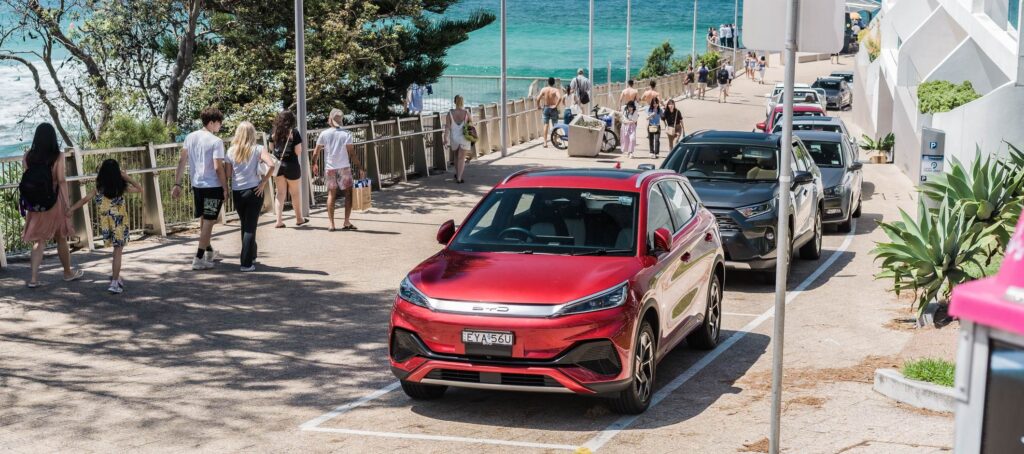
Statistics from the first half of 2025 show that Tesla Model Y is the most popular BEV, while BYD’s Shark 6 is the best selling PHEV – both models selling more than 10,000 in the first six months of last year. Outside of the dedicated EV manufacturers, the Mitsubishi Outlander, Kia EV5 and MG 4 were popular, each selling more than 2000 units in those six months.
How many EV charging stations are there in Australia?
The number of charging locations and charging plugs in Australia increased by around 20% between 2024 and 2025, with at least 4192 plugs being recorded in at least 1272 locations in 2025, compared with 3436 plugs and 1060 locations in 2024.
Which state in Australia has the most EVs?
Across all states, the percentage of new vehicle sales being EVs increased in the first half of 2025, however, it’s the ACT that stands way ahead of the other states and territories, with EVs accounting for more than 25% of new vehicle sales. Victoria comes in a not-very-close second with around 13%, and NSW with 12%. At the other end of the scale, EVs in the Northern Territory account for less than 5% of new vehicles sold.
How does Australia compare with other countries on EVs?
While the sales of EVs in Australia has increased steadily over recent years, we still trail significantly behind some other countries. In Australia around 12% of new vehicle sales are EVs, and there’s a similar story in New Zealand. Compared to the UK (31%), China (50%), Singapore (41%) and Sweden (43%) however, those numbers pale.
The global outliers at either end of the scale are Norway (96%), Japan (2%) and India (3%).
What does Australia’s increasing EV appetite mean for electrical contractors?
For electrical contractors, there’s a two-fold impact here. From a business vehicle perspective, it could be a good opportunity to invest in one of the EV utes which are proving increasingly popular. With the NVES impacting new EV prices, and a slowly-increasing number of EV utes on the market, it’s certainly worth considering.
Additionally, installing EV chargers is an excellent way to diversify revenue streams for your business – and the conversation doesn’t need to stop there.
With the government’s home battery incentive scheme, homeowners can get significant rebates on the installation of new batteries, and combined with solar and new smart home tech, there’s genuine opportunity here.
Social media can seem like a huge time drain. And, look, as anyone reading this will probably agree with, it absolutely can be. But, if you can be a little bit disciplined, and a little bit focused – and concentrate on using social media as a business and not as a way of wasting an [...]<p><a class="btn btn-secondary understrap-read-more-link" href="https://gemcell.com.au/news/instagram-tips-for-electricians/">Read More...<span class="screen-reader-text"> from Make Instagram Work For You – In Just 20 Minutes Each Day</span></a></p>
The concept of ‘buy local’ has been around for a long, long time, and rightly so – the initial appeal is pretty obvious: support local businesses that employ local people, and keep the money in the local community. However, as it’s been around for a long, long time, is there a risk it becomes background [...]<p><a class="btn btn-secondary understrap-read-more-link" href="https://gemcell.com.au/news/does-buy-local-still-work/">Read More...<span class="screen-reader-text"> from Does buy local still work? </span></a></p>
Confidently selling smart home technology There’s loads to know about the electrical industry – and one person can’t know all of the answers. Part of establishing an excellent reputation is about having an open mind, and being able to find out the answers for things you’re not too sure about. A conduit to knowledge, someone [...]<p><a class="btn btn-secondary understrap-read-more-link" href="https://gemcell.com.au/news/choosing-smart-home-tech/">Read More...<span class="screen-reader-text"> from Smart Home Technology for Electricians: Sell with Confidence</span></a></p>