Traffic Congestion Technology: Five Innovations Helping Reduce Delays
April 2, 2026
Traffic congestion is increasing in major cities as vehicle numbers continue to grow. In Australia alone, there are now 22.31 million registered vehicles, representing a 2.6% increase over the previous 12 months.
Public transport upgrades, cycling infrastructure and hybrid work arrangements may reduce some demand on roads. However, convenience remains a major factor in how people travel. As a result, researchers and engineers are developing new technologies designed to improve traffic flow and reduce congestion.
Below are five examples of technology currently helping address traffic congestion.
What is traffic congestion technology?
Traffic congestion technology refers to digital systems, sensors and AI-based tools used to improve how vehicles move through road networks.
These technologies analyse traffic volumes, predict congestion patterns and adjust road conditions in real time. Examples include:
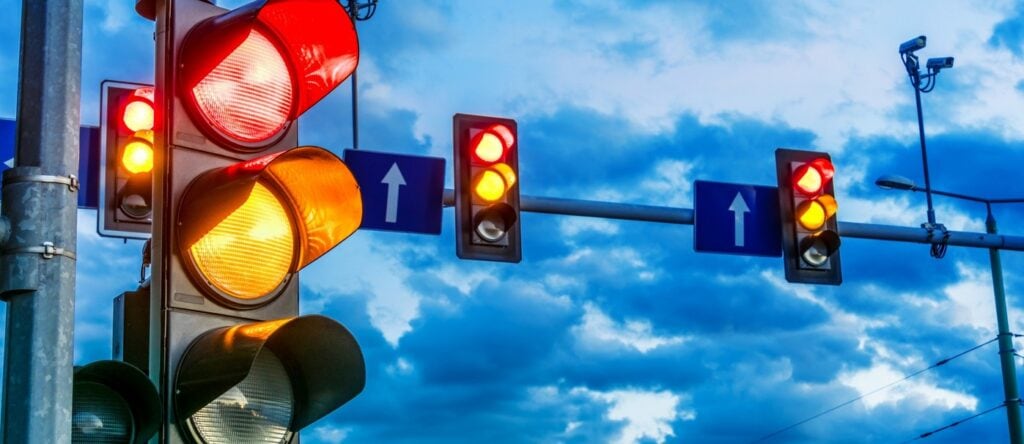
AI-powered traffic lights
smart highways with variable speed limits
predictive traffic routing systems
connected infrastructure for emergency vehicles
intelligent kerb management systems
The goal is to improve traffic flow, reduce delays and make road networks operate more efficiently.
Key takeaways for electrical contractors
Australia has more than 22.31 million registered vehicles, with numbers continuing to increase.
New technologies are being introduced to help cities manage growing traffic volumes.
AI-powered traffic lights and smart highways adjust traffic conditions in real time.
Predictive routing systems analyse traffic data to prevent congestion before it forms.
Kerb management systems help manage delivery traffic in busy urban areas.
How do smart traffic lights reduce congestion?
Traditional traffic lights operate on fixed timing cycles regardless of actual traffic conditions.
Smart traffic lights, however, use AI to analyse vehicle numbers and adjust signal timing in real time. Instead of running on timers, the system detects traffic queues and can extend green lights to allow vehicles to move through intersections more efficiently.
Cities including Pittsburgh and Los Angeles have reported travel time reductions of 20–40% using this technology.
In Australia, Transport for NSW is currently trialling several traffic light technologies designed to deliver more reliable journeys, reduce unnecessary stopping and better respond to changing traffic demand.
Using GPS or infrared sensors, ambulances, police vehicles and fire trucks communicate with traffic lights along their route. The system then adjusts signals to create a clear path for the emergency vehicle.
This reduces delays for emergency responders and helps prevent the chaotic traffic situations that often occur when drivers attempt to move aside at red lights.
How do smart highways and variable speed limits improve traffic flow?
Although they may sometimes appear unnecessary, these systems are designed to improve overall traffic flow. In heavy traffic conditions, vehicles braking suddenly can create an “accordion effect”, where waves of braking travel backwards through traffic and create delays.
Smart highway systems reduce this effect by adjusting speed limits to smooth traffic movement. By reducing sudden braking and stop-start traffic, these systems can make journeys both faster and safer.
As traffic volumes increase, this type of infrastructure is expected to become more common across road networks.
How does predictive AI routing prevent traffic jams?
Navigation apps such as Google Maps already redirect drivers when delays occur. Predictive AI routing systems go a step further by identifying congestion before it forms.
Systems like ORION, used by UPS in the United States, analyse more than 250 million data points to forecast where traffic congestion is likely to develop. Vehicles can then be rerouted early, helping distribute traffic more evenly across the road network.
By predicting congestion rather than simply reacting to it, these systems aim to reduce the formation of traffic bottlenecks.
What is intelligent kerb management?
In busy urban areas, delivery vehicles often contribute significantly to traffic congestion.
When vans or trucks circle city blocks looking for parking — or stop briefly in traffic lanes to unload goods — congestion can quickly increase.
Intelligent kerb management uses sensors embedded in kerbs and digital booking systems to manage loading zones. Delivery drivers can reserve a parking space in advance, allowing them to stop, unload and leave without blocking traffic lanes.
This helps improve traffic flow while still supporting essential delivery services.
Frequently asked questions about traffic congestion technology
Why is traffic congestion increasing?
Traffic congestion is increasing as populations grow and the number of vehicles on the road rises. In Australia, there are now more than 22 million registered vehicles, and the number continues to increase.
What are smart traffic lights?
Smart traffic lights are AI-powered systems that adjust signal timing based on real-time traffic conditions rather than fixed timers.
Do variable speed limits actually reduce congestion?
Yes. Variable speed limits help smooth traffic flow by preventing sudden braking waves that create delays.
How does predictive routing work?
Predictive routing systems analyse large datasets about traffic patterns to forecast where congestion may occur and reroute vehicles accordingly.
What electrical contractors need to know
Traffic congestion continues to increase as vehicle numbers rise and urban populations grow.
To manage this challenge, cities are introducing a range of technology-driven solutions including smart traffic lights, predictive routing systems, variable speed highways and intelligent kerb management. These systems aim to improve traffic flow, reduce delays and make road networks operate more efficiently as demand increases.
Discover the new-look Electrical Gems and what’s inside the Marketing & Reputation Issue for Australian electrical contractors.
[...]<p><a class="btn btn-secondary understrap-read-more-link" href="https://gemcell.com.au/news/electrical-gems-marketing-reputation-issue/">Read More...<span class="screen-reader-text"> from New launch: Electrical Gems – The Marketing & Reputation Issue</span></a></p>
The popular Ventair Stanza ceiling fan has been upgraded to an energy-efficient DC model, delivering a practical, modern solution for homes, classrooms, offices and light commercial spaces. Designed as a hassle-free retrofit, Stanza DC provides the power-saving benefits of DC motor technology while retaining the simplicity of a wall control. It is compatible with existing [...]<p><a class="btn btn-secondary understrap-read-more-link" href="https://gemcell.com.au/new-products/ventair-stanza-dc/">Read More...<span class="screen-reader-text"> from Ventair – Stanza DC</span></a></p>
The new LEDVANCE HouseGuard Security Floods are now available as a full family of products to suit every residntial application when you need instant light for safety and security. The range is available in both Back and White to complimentyour exterior colour. Single 12w ( Lumen package 1200lms ) and Twin 12w ( 24w Total [...]<p><a class="btn btn-secondary understrap-read-more-link" href="https://gemcell.com.au/new-products/ledvance-houseguard-security-floodlight/">Read More...<span class="screen-reader-text"> from LEDVANCE – HouseGuard Security Floodlight</span></a></p>