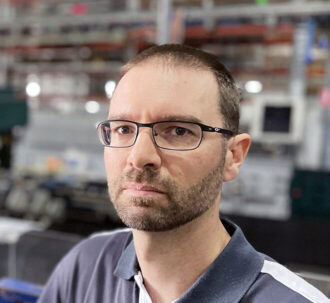
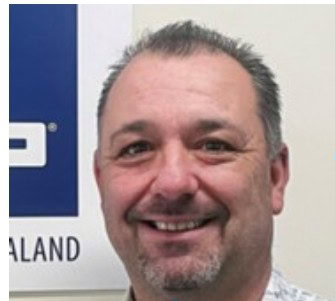
| OUR PANEL | ERIC STOCKER | ROBBIE ATTARD |
| Systems Engineer Manager
B&R Enclosures | Information Technology Manger NHP |
| How has it helped what you do? | As well as speeding things up and making us more efficient, technology has enabled us to model all of our products in 3D, which shows the manufacturability.
Being able to know we can make the product as per the design helps the customer.
We can give accurate lead times and achieve a better end result, and can provide specific, short-run solutions for Australian projects. | The biggest benefit has been that we have one single source of truth.
We’ve been able to fully trust the data because it’s coming from one source.
We’ve done a lot of work on our supply chain, our advanced warehousing and integration, as well as master planning and demand forecasting.
It’s giving us the ability to be nimble, and adapt and change when we need to. |
| And what hasn’t it done yet that you maybe thought it would do? | I’d hoped we’d have Augmented Reality on the shop floor now – putting on some VR goggles and helping the assembly team, so they know where the parts go without having to read complex drawings and so on.
Something else we’ve talked about but haven’t got to yet is our customer portal. It’d be nice to enable the customer to come in and design collaboratively with our engineers. | Not much from my perspective, but others might have had a different view initially – it’s not a silver bullet to solve everything.
It has highlighted the need for good data integrity – we’ve adopted machine learning and AI, but that’s only as good as what you put into it!
Having said that, it has laid the foundation for some key digital offerings we can now offer our customers. |
| What’s the most important aspect of introducing technology into a business? | It’s all about engagement.
You can’t just put any technology on the floor, it’s about working with people on how it will be used, and creating that system and process around it.
We’ve tried a couple of approaches, and what we’ve found is that if you design the system together with whoever’s using it, you get a far greater uptake. | Having an open mind and learning quickly is key.
You need to take an agile approach – implement things in chunks, use it, learn from it, adjust and review.
It’s progression, not perfection, that counts. |
| What’s on the agenda over the coming years, from a tech perspective? | I’d love to get more 3D designs into the shopfloor, and to have somewhere that the customer can go and see the progress of their order.
I can see us creating a Digital Twin, where we can model scenarios and factory layouts, driven by machine learning in order to optimise production plans.
This would enable us to reduce our stock on hand while increasing responsiveness. | We’re not stopping!
Some of the things we’re doing now are to try and improve our customer experience – improving our website so people can self-serve more, gain access to the information they need, and can trust its accuracy.
It’s important with the issues around supply chains and things being in stock, and we’re trying to make all of those interactions a lot quicker and easier. |