How To Get Year-Round Efficiency From An Aircon System
August 1, 2021
Aircon units are a vital part of almost every Australian home, and if you work with them, they bring responsibility too, explains Sean Russell from Master Electricians Australia.
Air conditioning care
Air conditioning safety
Aircon and isolation
Maintenance for aircon units
Most Australian households now have air conditioning installed and over the summer months they are vital machines for maintaining a habitable environment for many premises. You and your clients do not want to be stuck in the heat with units that are not running at optimum performance because they have been neglected or not been sufficiently maintained. Not only could air conditioning fail resulting in repairs and hefty bills, you may also be stuck with higher energy bills and insufficient cooling, resulting in disgruntled customers.
Care and maintenance for an aircon unit
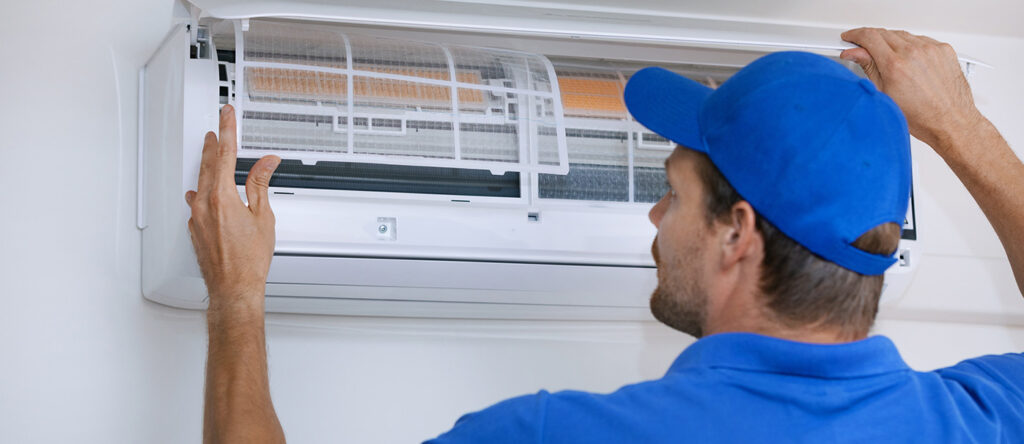
An air conditioner’s filters, coils, drainage, and fins require regular maintenance for the unit to function effectively and efficiently throughout its years of service. Common problems that occur with neglected units include; blocked filters, failed or faulty thermostats, refrigerant leaks, blocked drainage, failed or faulty capacitors, compressor failure, worn contacts in the electrical connections for the compressor, blower motor or condenser fan. Arcing or pitting of contacts can result in dirty or damaged contacts which ultimately fail. Neglecting necessary maintenance ensures a steady decline in air conditioning performance while energy use steadily increases.
Regular maintenance is a great habit to get into, resulting in a well-functioning system, a healthier home environment and lower energy bills. From a homeowner’s point of view, it should be easy: following the manufactures instructions clean or replace the filters, clean leaves, dust, or dirt out of the outdoor units, ensure the condensation drain is clear of debris and book in a local electrical contractor to conduct an annual check and maintenance inspection.
Safety measures in aircon maintenance
For the sparkie — never attempt maintenance work that you are not competent and licensed to do. Prior to commencing work ensure you have put safety first. Before doing any maintenance or electrical work that may require you to be near live parts make sure you render the system safe by isolating and locking off the circuit breaker or local isolator.
Older units may not have the lockable isolators although they may have complied at the time of installation. A few key things to know about this situation is that under clause 2.6.3.2.6 of AS/NZS 3000, the unit may look, or even be, brand new because of the repair clause. You can replace with an equivalent item in the same location without needing to bring up to current standards.
If you extend, shorten, or move the wiring and if you change the load requirements of that circuit, for example it was on a 16A breaker and it now requires a 20A, this turns into an Alteration (AS/NZS 3000, 2.6.3.2.5) which will trigger the requirement to comply with today’s standards, for example RCDs and lockable isolators.
“A common misconception is that if the outdoor unit is close to the switchboard, it does not need an isolator. This is not the case.”
Does aircon always need an isolator?
A common misconception is that if the outdoor unit is close to the switchboard, it does not need an isolator. This is not the case, air conditioning and heat pump systems incorporating a compressor shall be provided with an isolating switch (lockable) in accordance with AS/NZS 3000 Clause 2.3.2.2. Isolators must be installed adjacent to but not on the unit, which isolates all parts of the system, including ancillary equipment, such as head units, from the same location and this is regardless of how close they are to the switchboard.
The only exception to this is the isolating switch may be installed at the switchboard supplying the system if the switchboard is dedicated to the equipment (for example an air conditioning plant room).
Discover the new-look Electrical Gems and what’s inside the Marketing & Reputation Issue for Australian electrical contractors.
[...]<p><a class="btn btn-secondary understrap-read-more-link" href="https://gemcell.com.au/news/electrical-gems-marketing-reputation-issue/">Read More...<span class="screen-reader-text"> from New launch: Electrical Gems – The Marketing & Reputation Issue</span></a></p>
The popular Ventair Stanza ceiling fan has been upgraded to an energy-efficient DC model, delivering a practical, modern solution for homes, classrooms, offices and light commercial spaces. Designed as a hassle-free retrofit, Stanza DC provides the power-saving benefits of DC motor technology while retaining the simplicity of a wall control. It is compatible with existing [...]<p><a class="btn btn-secondary understrap-read-more-link" href="https://gemcell.com.au/new-products/ventair-stanza-dc/">Read More...<span class="screen-reader-text"> from Ventair – Stanza DC</span></a></p>
The new LEDVANCE HouseGuard Security Floods are now available as a full family of products to suit every residntial application when you need instant light for safety and security. The range is available in both Back and White to complimentyour exterior colour. Single 12w ( Lumen package 1200lms ) and Twin 12w ( 24w Total [...]<p><a class="btn btn-secondary understrap-read-more-link" href="https://gemcell.com.au/new-products/ledvance-houseguard-security-floodlight/">Read More...<span class="screen-reader-text"> from LEDVANCE – HouseGuard Security Floodlight</span></a></p>