Understanding your duty of care as an electrical contractor
December 3, 2025
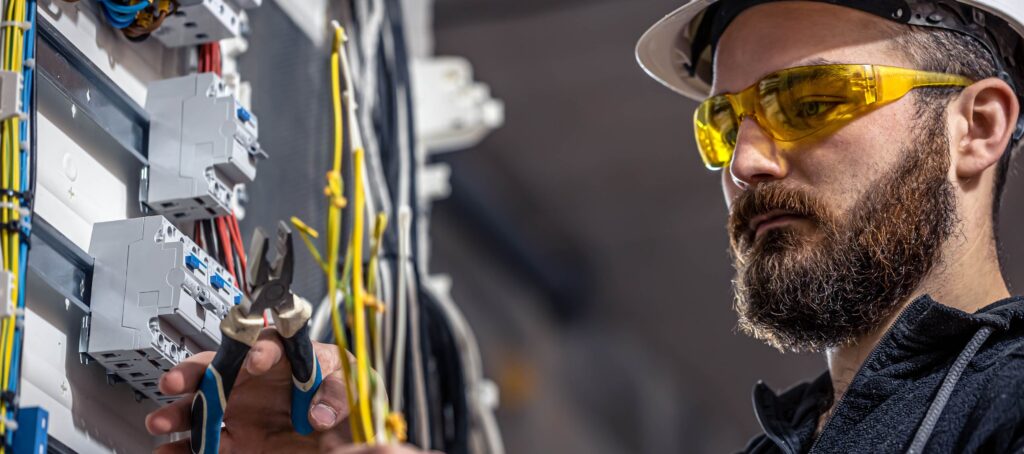
Safety on site is everyone’s responsibility – and while it’s easy to take for granted, it’s essential you own it every single day.
Everyone has a duty of care to ensure their workplace feels safe. Whether you’re the owner, an employee, or up-and-coming trainee, we all need to play our part in making sure our place of work, the equipment we use and the systems we adhere to are safe, secure and properly maintained.
Of course, if you’re the business owner and employer, under Australian WHS/OHS laws the buck ultimately stops with you. You’re what’s known as the ‘primary duty of care’ – meaning you carry the main responsibility for the health and safety of everyone in your workplace. This includes psychosocial hazards as well as physical safety.
In this article we’re focusing on physical safety on site – but what exactly does that involve? We asked Damin Murdock, Director of Sydney-based Leo Lawyers Pty Limited, to get us up to speed.
Tell us in layman’s terms, what is a duty of care?
Damin says, “A duty of care generally means someone owes a duty to carry out works with reasonable care or skill to the same level that another person, in the same or similar industry, would have carried out. Each State and Territory have various statutory duties regarding an electrician’s duty of care to ensure that the equipment and electrical works are free from electrical risk.”
How do the responsibilities change from state to state?
The key message here is to check with your own State or Territory, as the specifics may change – however the general principle remains the same: it’s on you to keep people safe.
Damin says, “For instance, pursuant to s 30 of the Electrical Safety Act 2002 (Queensland), there is a duty to ensure that all electrical equipment used is electrically safe, and that the performance of electrical work ensures the electrical safety of all persons and property likely to be affected by the electrical work.”
There is a further duty of care imposed across each State and Territory regarding an electrician’s duty of care to ensure that the works are carried out in a good and workmanlike manner.
“Under the Home Building Act 1989 (New South Wales) (the HB Act) and its regulations, electrical wiring work is defined as ‘specialist work’, and specialist work is included within the meaning of ‘residential building work’,” says Damin.
“Section 18B of the HB Act states that a holder of a contractor licence (including electrical licence) provides a warranty that the works will be done with due care and skill; the materials supplied will be good and suitable for the purpose; the work will comply with any applicable laws; and the work will be done within a reasonable period of time. Similarly, section 8 of the Domestic Building Contracts Act 1995 (Victoria) has similar provisions.
“That also extends to anyone in contact with the business’ electrical equipment and electrical works, including employees and contractors, property tenants and visitors.”
Again, the key message is this – check with your State or Territory to ensure you’re on the right side of the law.
The importance of getting it right
While the ‘she’ll be right’ approach is still an often endearing part of Australian culture, this is definitely one to take an opposing view. Safety on site is a hugely important thing to get right, because as Damin explains there’s a lot at stake.
“If an electrician is found to breach its duty of care, oftentimes that is deemed an offence within the State-based legislation,” he says.
“The consequences are civil penalties, conditions imposed on a licence (such as attendance to courses), suspension of licences, cancellation of licences, and criminal offences. When there is a breach of a duty of care, this may also result in an electrician no longer being a fit and proper person to hold a contractor licence, and being barred from having its licence renewed for a certain period of time, for instance, three to ten years.”
What if I’m employing a subcontractor? Am I still responsible?
Short answer? Yep. But if you’re subbing you have responsibility too.
Damin says, “Generally speaking, if an electrician subcontracts work, the electrician is responsible for the subcontractor’s work under contract. The same applies for the carrying out of the works in accordance with the implied duties of care.
“However, although the electrician may be ultimately responsible, it may have a counterclaim against the subcontractor. Same thing in terms of health and safety, if a subcontractor was injured at a job site, the electrician will generally be responsible, unless it can be shown that it has complied with its duty of care, and it was the subcontractor that was negligent.”
How to protect yourself
Of course, you can do all of the right things, but accidents can happen or people go rogue. That’s why it’s important to keep records. Nine hundred and ninety nine times out of a thousand you won’t need them. Come that one time however…
“Further, an electrician should keep details of the electrical equipment or materials used, photographs, and invoices of the product and place of purchase.
“Finally, maintaining a record of any electrical design that may have been created by an electrical engineer that has been relied upon by the electrician is essential. This is because it may be the electrical design that was the fault, not the electrical works performed. In these circumstances, the electrician would be able to bring a claim against the designer of the electrical design.”
While it’s easy to be distracted by the day-to-day realities of work – that next job, that next challenges – safety should be a priority every single day.
Damin says, “We recommend all tradespeople take photographs of their works before they commence, during the process, and on completion. This is to ensure they have a record of exactly what works were completed by them, so that they have evidence in the event someone has intervened with their works, and subsequently, tries to pass blame onto them after the fact.
Response Radiance The Response Radiance with heater, exhaust fan and light sets a new benchmark for 3 in 1 bathroom units. Its modern and sleek design will seamlessly compliment any bathroom or ensuite style. It has been engineered to efficiently exhaust steam and odours, deliver instant heat, and provide effective lighting within the room. Its [...]<p><a class="btn btn-secondary understrap-read-more-link" href="https://gemcell.com.au/products/fantech-response-radiance-3-in-1-bathroom-heater/">Read More...<span class="screen-reader-text"> from Fantech – Response Radiance 3 in 1 Bathroom Heater, Exhaust Fan & Light</span></a></p>
Using SMART goals is a great way to achieve your ambitions – rather than having them fall by the wayside. Here’s what you need to know. [...]<p><a class="btn btn-secondary understrap-read-more-link" href="https://gemcell.com.au/news/setting-realistic-business-goals-for-2026-a-smart-approach-for-electricians/">Read More...<span class="screen-reader-text"> from Setting SMART goals for your electrical contracting business</span></a></p>
Using modern design principles, the Iconic Sweep fan will integrate into its environment by adding to its appeal while providing the performance needed and expected. These ceiling sweep fans are part of Clipsal’s market leading AirflowTM range. Suitable for efficiently moving air within and between rooms in both residential and commercial buildings. They help reduce [...]<p><a class="btn btn-secondary understrap-read-more-link" href="https://gemcell.com.au/products/clipsal-by-schneider-dc-fan/">Read More...<span class="screen-reader-text"> from Clipsal by Schneider DC Fan</span></a></p>