Urban design – the crucial ingredient for successful infrastructure
June 10, 2025
How urban design creates the world around us
When new infrastructure is created, it takes a heady mix of art and science to get the urban design just right.
Every day, we take actions that other people want us to take.
We behave in a way that other people want us to behave, and our mood is affected based on how other people want us to feel.
This isn’t some tale of dystopian Australia, however, or some commentary on how we’re all being manipulated by the media – this is good, solid user-based infrastructure and urban design, and it’s a lot smarter than many of us probably realise.
And when you’re working on projects like these, it’s always good to understand the why, as well as the what!
Today, behavioural science and psychology – urban design – plays just as big a role as technical design does when it comes to how our infrastructure is created, and how it’s subsequently evolved.
Behavioural infrastructure development brings the very best of environmental psychology, behavioural economics, and neuroscience together to create the world around us.
Environmental psychology explores how spaces impact the emotions we feel and the actions we take. Behavioural economics, meanwhile, introduces the concept of nudges – subtle design elements guiding desirable behaviours without (too much!) coercion.
Neuroscientific research, meanwhile, shows just how physical environments activate the specific brain areas that influence decision-making and emotional responses.
The application of neuroscience enables designers to predict and influence how communities interact with their surroundings, and design infrastructure based on how they want people to behave and use the facilities.
Clever stuff.
Nudging in the right direction
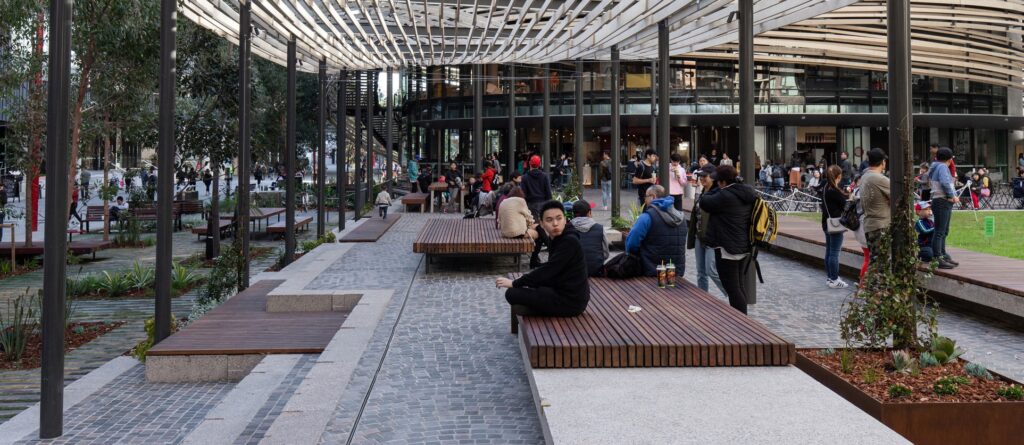
A great example of ‘nudging’ is Sydney’s Darling Square. It’s been developed gradually over the past decade, and today is a thriving public space behind Darling Harbour attracting locals, workers and tourists alike.
The strategic placement of amenities, communal seating and interactive landscapes guide and prompt community interaction, which enhance social connectivity and encourage connection.
Slowing down to speed up
Of course, we’re all familiar with road signs that point you the way the local council wants the traffic to go, rather than the quickest way to reach your destination (we always appreciate the shortcut kings and queens!). But even when it comes to our roads, there’s a lot more to them than meets the eye.
Take, for example, the Safe Active Streets initiative in Western Australia, which creates safer, more accessible roads in local communities using a number of tactics.
Entry points to the 30km/h streets are either raised or narrowed, which automatically promotes a slower speed and acts as an alert to drivers that they’re entering a safe active street. Turn restrictions, narrowed lanes and single-lane slow points directly impact driver behavior, while the presence of cycle lanes and newly planted trees provide visual cues to drive more slowly.
Of course, it might scupper that shortcut, but the community impact is pretty impressive, creating a more pleasant environment while decreasing the risk of accidents, too – and it’s a good illustration of how those small visual cues can significantly change behaviour.
How tech is helping infrastructure usage
This wouldn’t really be a current story if it didn’t have some sort of tech or AI angle, would it? We never want to disappoint, so to round things off we’re taking a trip to Parramatta, NSW. The city’s Smart City Innovation Strategy 2024-2033 details some pretty impressive and innovative advancements to help create innovative infrastructure that “improves how people live, work and play”.
There’s a load of cool stuff that’s happening in Parra, including movable planter boxes. Planter boxes help cool spaces, and the moveable planter boxes in Parramatta and Centenary Squares have proven the concept over the past two summers in trials.
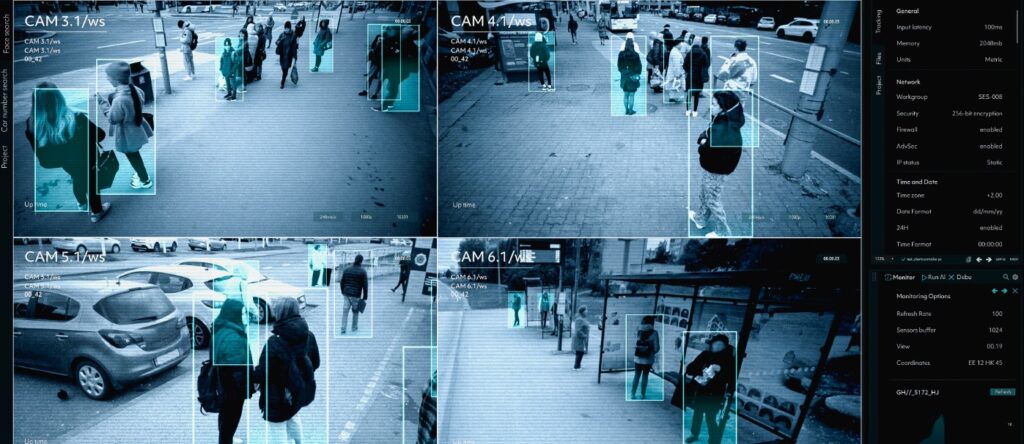
In the city’s Phillip Street, meanwhile, water misters have been installed and technology monitors pedestrian and vehicle counts, enabling the street to be responsive to both the climate and different user groups, too.
Creating the infrastructure of tomorrow isn’t just about meeting demand and need – it’s increasingly focused on promoting the right outcomes and encouraging the right behaviours, whether you’re fully aware of it, or not…
I walk the line
Much of our infrastructure development here in Australia is either the redevelopment of existing assets or extending current infrastructure rather than entirely new developments.
And even when there is a completely new development, we’re bound to some degree by expectations and norms – some of which are valid, others which are more down to convention than anything else.
A development in Saudi Arabia, however, is throwing out those norms, and could redefine how we live.
Part of the NEOM sustainable region project taking place in northwest Saudi Arabia, THE LINE is a planned development – stretching across 170 kilometres but only 200 metres wide – that will house nine million people. It will have no roads, no cars, and no emissions. It will run on 100% renewable energy and 95% of the land will be used by nature.
Artist’s impression of NEOM’s The Line.
City functions will be ‘layered vertically’ enabling people to move seamlessly up, down and across – a concept called Zero Gravity Urbanism, with public parks, pedestrian areas, schools, homes and places for work all layered.
Every resident will have all daily essentials within five minutes, and a high-speed rail will see end-to-end transit in 20 minutes.
It’s being sold as a ‘place of unparalleled social and economic experimentation’ coupled with world-class preventative health care, a place built around humans and not technology, but able to predict and react to what people need, as opposed to the other way around.
In a press statement, Mohammed bin Salman, the Crown Prince and Chairman of the NEOM Board of Directors said: “THE LINE will tackle the challenges facing humanity in urban life today and will shine a light on alternative ways to live. We cannot ignore the liveability and environmental crises facing our world’s cities, and NEOM is at the forefront of delivering new and imaginative solutions to address these issues. NEOM is leading a team of the brightest minds in architecture, engineering and construction to make the idea of building upwards a reality.”
Perhaps creating the impression of a dystopian movie, this long, thin, purpose-built living space will have an outer mirror facade that enables its small footprint to blend with nature.
Related Articles
Want to read more on urban planning? We think you may like this article.
A practical guide to staff expenses for tradies, covering expense policies, receipts, approvals, red flags and job-level cost tracking. [...]<p><a class="btn btn-secondary understrap-read-more-link" href="https://gemcell.com.au/news/staff-expenses-tradies-electrical-business/">Read More...<span class="screen-reader-text"> from Staff expenses 101 – a tradie’s guide</span></a></p>
What electrical contractors need to know about security camera installation, privacy, audio recording, placement and practical compliance. [...]<p><a class="btn btn-secondary understrap-read-more-link" href="https://gemcell.com.au/news/security-camera-installation-electrical-contractors/">Read More...<span class="screen-reader-text"> from Caught On Camera: The Dos And Don’ts Of Security Camera Installation For Electrical Contractors </span></a></p>
Explore insurance for electrical contractors, including public liability, professional indemnity, personal injury, tools and trailer cover. [...]<p><a class="btn btn-secondary understrap-read-more-link" href="https://gemcell.com.au/news/insurance-for-electrical-contractors/">Read More...<span class="screen-reader-text"> from Insurance For Electrical Contractors: What Cover Should You Consider?</span></a></p>