Changing connections through innovation in cabling and wiring
October 1, 2022
Some familiar issues are driving change when it comes to cabling and wiring devices.
In the future we will see safer, more sustainable and smarter cabling and wiring
Demand for sustainable wiring is growing
Large residential projects are still relying on cabling rather than moving towards wireless products
Change is a staple of many industries and product sectors, and cabling and wiring are no different, with three familiar topics emerging as drivers of innovation and change:
Safety
Sustainability
Connectivity
“The market is looking at a safer and more reliable product,” says Shuai Wang of Prysmian.
“One of the traditional products in residential, is a PVC insulated TPS cable – it’s probably been used in Australia for 20 to 30 years – however, in the past five to 10 years, we’ve been talking more about the safety of the wire when a fire happens.
“A major consideration is the toxicity of the by-products of the cable when it’s burning. Research from Europe has shown that 80 per cent of fire fatalities happen not due to the fire itself, but because people cannot evacuate and they inhale toxic gases produced by the fire,” Shuai says.
“Bigger developments, such as hospitals and schools, are using a low smoke, zero halogen product, for example, which is more reliable and offers better safety.”
Sustainable Cables
The vast majority of people now accept the climate crisis, and businesses of all sizes are resolute in playing their part to help protect the long-term interests of the planet.
“We all know the world’s facing a lot of challenges, including our countries suffering from pollution and climate change. So as a business, we’re thinking about how we can make every single product, including cable itself, more sustainable,” says Shuai Wang of Prysmian.
“From a Prysmian point of view, we started evaluating this at least four or five years ago. We have put a system in place to evaluate the carbon footprint during manufcture, to give us better insight into how we can work through that.
“We are also taking more initiative to categorise our products as eco products where we can, and investing in research to explore how we can utilise our material compounds and recycle other products. For example, can we sell or even give polyethylene to suppliers so they can use them to create a drum bobbin that we can use and reuse?
“We’re also working with universities to try to find a way to recycle cable. We’re actually working with one of our partners to see how we can recycle cable in a way that generates some by-products that can be used in the oil field or other industries.”
Keeping connected through data cabling
Data cabling and subsequent connectivity is becoming increasingly important, too.
“There are some standards coming out now, where you’ll find a lot more of those products are getting ethernet connectivity,” says Brett Coppins, Light & Room Control Offer Manager at Schneider Electric.
“Here at Schneider, we are moving towards more products with upper-level connectivity via various industry-recognised methods, as well as newer emerging technologies.
“And that’s a great thing because you’ll find that the majority of device manufacturers will now support their devices connecting to a communication layer and allowing various third-party systems integration via an API or even a natively designed interface if the market size can warrant the dev cost.”
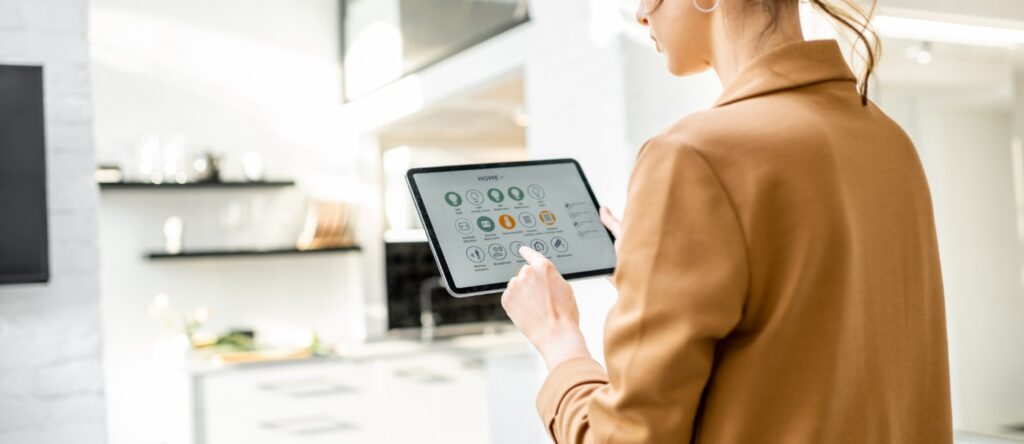
While an increasing number of small to mid-sized residential projects are looking to wireless products, larger prestige residential projects are still relying upon cabled devices as a first choice, says Brett.
“When you’re talking about your larger footprint buildings and high-end residential, you’ll find that installers still lean towards ‘cabled’ smart products, like SpaceLogic C-Bus.
“Part of that is due to wireless transmission distances being affected by high density building materials for the walls – where the wireless signal may not transmit as easily through featured materials like concrete, stone or brick walls, for example – or because they’ve got a boatshed or a man cave 50 metres down the backyard that’s the size of some people’s smaller houses, so they use cabled systems to ensure the reliability is there.
“Often there are a number of other systems to be integrated with the lighting control, such as HVAC.
“On these large projects most installations aren’t using smaller split systems anymore and have moved to centralised models like commercial VRV/ VRF ducted systems, where integration to other systems is a key factor,“ Brett says.
Larger commercial projects, especially multi-tenanted office buildings or campuses still favour wired/cabled type products as their first choice for lighting and HVAC controls due to rapid commissioning time, ease of deployment, as well as providing increased security for the many tenants and their separate spaces.
Discover the new-look Electrical Gems and what’s inside the Marketing & Reputation Issue for Australian electrical contractors.
[...]<p><a class="btn btn-secondary understrap-read-more-link" href="https://gemcell.com.au/news/electrical-gems-marketing-reputation-issue/">Read More...<span class="screen-reader-text"> from New launch: Electrical Gems – The Marketing & Reputation Issue</span></a></p>
The popular Ventair Stanza ceiling fan has been upgraded to an energy-efficient DC model, delivering a practical, modern solution for homes, classrooms, offices and light commercial spaces. Designed as a hassle-free retrofit, Stanza DC provides the power-saving benefits of DC motor technology while retaining the simplicity of a wall control. It is compatible with existing [...]<p><a class="btn btn-secondary understrap-read-more-link" href="https://gemcell.com.au/new-products/ventair-stanza-dc/">Read More...<span class="screen-reader-text"> from Ventair – Stanza DC</span></a></p>
The new LEDVANCE HouseGuard Security Floods are now available as a full family of products to suit every residntial application when you need instant light for safety and security. The range is available in both Back and White to complimentyour exterior colour. Single 12w ( Lumen package 1200lms ) and Twin 12w ( 24w Total [...]<p><a class="btn btn-secondary understrap-read-more-link" href="https://gemcell.com.au/new-products/ledvance-houseguard-security-floodlight/">Read More...<span class="screen-reader-text"> from LEDVANCE – HouseGuard Security Floodlight</span></a></p>