Autonomous Vehicles: How Close Are Self-Driving Cars?
April 1, 2026
Autonomous vehicles have been discussed for years, often as a major technological shift that would rapidly transform transport. Despite the early hype during the 2010s, the widespread arrival of self-driving cars has taken longer than many predicted.
Like many new technologies, development has followed a familiar pattern. Initial excitement was followed by a quieter period as technical challenges emerged and expectations adjusted. Today, however, development continues steadily behind the scenes as companies and governments test new capabilities and regulatory frameworks.
Globally, autonomous vehicle trials are expanding. According to a McKinsey paper published earlier this year, more than 35 pilot schemes have taken place in Europe. The United States now sees more than 450,000 autonomous vehicle rides per week, while China records more than 250,000.
What is an autonomous vehicle?
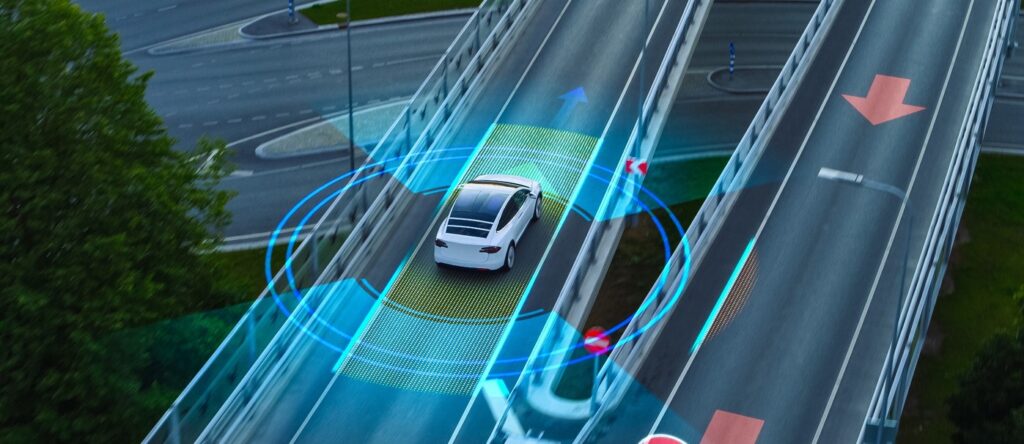
An autonomous vehicle is a vehicle that can drive itself using technologies such as artificial intelligence, sensors and advanced computing systems.
These vehicles rely on systems that analyse their surroundings, interpret road conditions and make driving decisions without direct human control. Technologies supporting autonomous driving include:
AI systems that interpret complex driving scenarios
LiDAR sensors that create a 3D laser map of surroundings
Vehicle-to-Everything (V2X) communication that allows vehicles to interact with traffic lights and other vehicles
Advances in computing power are also supporting development. NVIDIA’s Rubin platform, unveiled at CES 2026, is designed to provide the computing power needed to run reasoning-based AI models inside vehicles in real time.
Key takeaways for electrical contractors
Autonomous vehicle trials are expanding globally, with significant activity in the US, Europe and China.
Most vehicles currently on the road operate at Level 2+ automation, meaning drivers still remain responsible for driving.
Robotaxis operating at Level 4 automation are among the most advanced real-world autonomous vehicle applications today.
High software development and technology costs remain one of the biggest barriers to widespread adoption.
Regulation and legislation are evolving worldwide as governments attempt to keep pace with the technology.
What are the six levels of vehicle automation?
Vehicle automation is defined by the Society of Automotive Engineers (SAE) through six levels, ranging from fully manual driving to complete autonomy.
Level 0: Fully manual driving
Level 1–2: Driver assistance systems such as cruise control and lane keeping
Level 3: Conditional automation where drivers may take their eyes off the road in certain conditions
Level 4: High automation with no driver intervention required in specific operating environments
Level 5: Full automation in all driving conditions
Most vehicles on the road today sit at Level 2+, where the driver must keep their hands on the wheel and remain attentive, although systems such as cruise control, parking assistance and lane-keeping are common.
Higher-end vehicles are beginning to move further along the automation scale. Vehicles from Mercedes-Benz and BMW enabling Level 3 highway driving — where drivers may take their eyes off the road under certain conditions — are expected to gain attention.
Why are robotaxis leading autonomous vehicle adoption?
Robotaxis are among the most advanced real-world uses of autonomous vehicles.
These vehicles typically operate at Level 4 automation, meaning the vehicle can drive itself without human intervention but only within defined conditions and environments. If those conditions are not met, the vehicle will not operate.
Many robotaxi services use geofencing, which limits the vehicle to a predefined operating area.
Companies including Waymo and Amazon’s Zoox have expanded their robotaxi operations beyond early pilot programs in cities such as Phoenix and San Francisco. These services are now expanding into larger global centres such as Tokyo and London as legislation supporting automated vehicles emerges.
Other mobility platforms including Lyft and Uber are also entering the robotaxi market, suggesting the sector could develop quickly as technology and regulation mature. There have, predictably, been teething problems, though.
When will autonomous vehicles become mainstream?
Despite progress, widespread adoption of autonomous vehicles is still expected to take time.
According to McKinsey’s report, forecasts for advanced autonomous driving have already been pushed back. An L4 urban pilot for passenger cars is now estimated for 2032, compared with earlier expectations of 2030.
Meanwhile:
L3 highway pilots are expected this year in China
North America may see them by 2028
APAC is expected to follow by 2029
By 2035, the largest market segment for privately owned vehicles is expected to remain Level 2+ automation, while Level 3 functionality is likely to remain a niche option in premium vehicles.
One of the biggest barriers remains cost. Software development, testing, integration, data storage and hardware components are all described as “very high” cost areas, and these costs ultimately flow through to consumers.
Is AI capable of making safe driving decisions?
Autonomous vehicles rely heavily on artificial intelligence to interpret situations and make driving decisions.
However, AI decision-making still raises important questions. Many drivers have experienced automated braking systems reacting to harmless objects such as plastic bags on the road, highlighting how complex real-world decision-making can be.
Advances in reasoning-based AI aim to improve how vehicles analyse and respond to these scenarios.
However, ethical questions remain. One example often raised in public surveys is how an AI system should prioritise safety if a crash becomes unavoidable — a decision that many people find difficult to resolve.
How are governments regulating autonomous vehicles?
Regulation remains one of the biggest challenges for autonomous vehicles, as legislation often struggles to keep pace with rapid technological development.
In the United States, regulations currently vary between states. Jurisdictions such as California and Arizona support automated vehicles, while others have stricter limitations. To address this, the US has introduced the Self Drive Act of 2026, aimed at creating a national safety standard.
In Europe, the EU AI Act will classify autonomous vehicles as “high-risk AI”, requiring strict data governance, transparency and human oversight.
China permits Level 3 and Level 4 vehicles to be sold to private consumers
Japan allows Level 4 remote-only operations for rural transport services such as shuttles for elderly passengers
Frequently asked questions about autonomous vehicles
What level of automation do most vehicles currently have?
Most vehicles currently operate at Level 2+ automation, meaning drivers remain responsible for driving but can use assistance systems such as cruise control, lane keeping and parking support.
What is a robotaxi?
A robotaxi is an autonomous vehicle used as a ride service. These vehicles typically operate at Level 4 automation within specific geographic areas using geofencing.
When could Level 4 autonomous cars become common?
Forecasts suggest an L4 urban pilot for passenger cars may occur around 2032, although timelines have already shifted.
Why are autonomous vehicles expensive?
Costs remain high due to software development, integration, testing, data storage and the hardware required to support autonomous systems.
What electrical contractors need to know
Autonomous vehicles continue to develop globally, although widespread adoption will likely take longer than early predictions suggested.
For now, most vehicles remain at Level 2 automation, while robotaxis operating in limited environments are pushing the technology forward. High development costs, ethical considerations and evolving legislation will continue shaping how quickly self-driving vehicles become mainstream.
Explore insurance for electrical contractors, including public liability, professional indemnity, personal injury, tools and trailer cover. [...]<p><a class="btn btn-secondary understrap-read-more-link" href="https://gemcell.com.au/news/insurance-for-electrical-contractors/">Read More...<span class="screen-reader-text"> from Insurance For Electrical Contractors: What Cover Should You Consider?</span></a></p>
Discover the new-look Electrical Gems and what’s inside the Marketing & Reputation Issue for Australian electrical contractors.
[...]<p><a class="btn btn-secondary understrap-read-more-link" href="https://gemcell.com.au/news/electrical-gems-marketing-reputation-issue/">Read More...<span class="screen-reader-text"> from New launch: Electrical Gems – The Marketing & Reputation Issue</span></a></p>
The popular Ventair Stanza ceiling fan has been upgraded to an energy-efficient DC model, delivering a practical, modern solution for homes, classrooms, offices and light commercial spaces. Designed as a hassle-free retrofit, Stanza DC provides the power-saving benefits of DC motor technology while retaining the simplicity of a wall control. It is compatible with existing [...]<p><a class="btn btn-secondary understrap-read-more-link" href="https://gemcell.com.au/new-products/ventair-stanza-dc/">Read More...<span class="screen-reader-text"> from Ventair – Stanza DC</span></a></p>